
The Hidden Connection: How Your Roof and Siding Control Your Basement Moisture in Rhode Island
Ask any homeowner in Cranston, Warwick, or Johnston about their biggest property headache, and there’s a high probability they’ll point down toward the cellar stairs. Rhode Island is notorious for wet basements. Between our high coastal water tables, dense clay and rocky soil mixes, and heavy seasonal downpours, keeping a lower level dry feels like a constant battle.
When a basement feels damp or starts pooling water after a heavy New England rainstorm, most homeowners immediately look inward. They buy expensive heavy-duty dehumidifiers, get quotes for interior French drains, or coat their concrete walls in waterproof paint.
However, looking inward usually addresses the symptom rather than the source. In building science, water management is a top-down problem. The secret to a bone-dry basement doesn’t start in the cellar—it starts at your roof ridge and flows all the way down your siding.
The “Waterfall Effect”: How Exterior Infrastructure Controls Foundation Health
To understand why your basement is damp, you have to look at how water behaves when it strikes your home’s exterior envelope. Your home is engineered to shed thousands of gallons of water during a standard coastal storm. If any part of that shedding system is compromised, that water doesn’t magically vanish—it concentrates directly against your foundation.
Consider a standard 2,000-square-foot roof. During a storm that drops just one inch of rain, that roof collects roughly 1,250 gallons of water.
[1 Inch of Rain] ➔ [2,000 Sq. Ft. Roof] ➔ [1,250 Gallons of Water Collected]
                                                        │
                      ┌─────────────────────────────────┴─────────────────────────────────┐
                      ▼                                                                   ▼
         【Properly Functioning Roof & Gutters】                           【Compromised Shingles, Sagging Gutters, or Leaky Siding】
                      │                                                                   │
                      ▼                                                                   ▼
  [Water channeled safely away from house]                            [Water dumps directly along the foundation wall]
                      │                                                                   │
                      ▼                                                                   ▼
         🌳 HYDROSTATIC PRESSURE LOWERED 🌳                                    🌧️ HYDROSTATIC PRESSURE SPIKES 🌧️
                      │                                                                   │
                      ▼                                                                   ▼
           ✨ Bone-Dry Basement ✨                                             ❌ Hydrostatic Pressure forces water through porous ❌
                                                                                  concrete, creating leaks, mold, and shifting soil.
If your roofing, gutters, and siding are doing their jobs, those 1,250 gallons are collected seamlessly and channeled safely away from your structure. But if your exterior infrastructure is failing, a massive volume of water dumps directly onto the soil right next to your foundation walls.
When soil becomes oversaturated, it triggers a phenomenon known as hydrostatic pressure. Water is incredibly heavy. As the soil expands with water, it exerts immense physical pressure against your concrete foundation blocks. Because concrete is inherently porous, that pressure forces moisture directly through the walls, resulting in:
-
Fine, powdery white mineral deposits (efflorescence) on your cellar walls.
-
High indoor humidity and a musty smell throughout the house.
-
Cracks in the foundation floor or walls.
-
Active pooling and flooding in low spots.
1. The Roof’s Role: Pitch, Shingles, and Disastrous Valley Failures
Your roof acts as the primary collection funnel for your entire property. If the roof system is compromised, water transitions from a controlled flow into an unpredictable structural hazard.
Wind-Damaged and Aging Shingles
When asphalt shingles age, they curl, crack, and lose their protective granule coating. During a severe nor’easter, wind uplift can tear these weakened shingles away completely. When rain breaches these bare spots, it travels along the plywood roof deck.
While some of this water drips directly into your attic, a significant portion often tracks sideways, bypassing your gutter system entirely and cascading directly down your home’s exterior walls to saturate the foundation perimeter.
Failing Roof Valleys
The valleys—where two sloping roof sections meet—handle the highest volume and velocity of water on your home. If a valley is improperly flashed or choked with debris, water can overflow the sides of the valley channel. Instead of traveling safely into your gutters, this concentrated stream overshoots the roofline entirely, pounding the ground below like a high-powered pressure washer and rapidly eroding the grading around your home.

2. The Gutter System: The Vital Bridge Between Roof and Soil
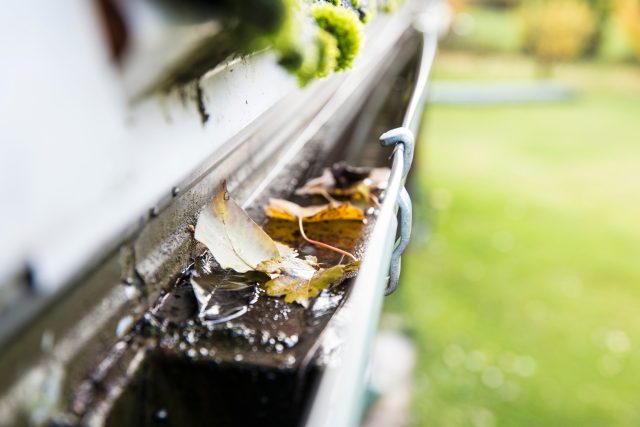
You cannot talk about roof performance without talking about gutters. Gutters are the vital bridge that transports water away from your home’s perimeter. When they fail, basement flooding is almost guaranteed.
| Gutter Defect | Immediate Consequence | Impact on Your Basement |
| Clogged Channels & Leaf Dams | Water backs up and overflows over the front lip of the gutter. | Thousands of gallons of water pool directly against the foundation wall, spiking hydrostatic pressure. |
| Improper Pithing & Sagging | Water pools in low spots instead of moving toward the downspouts. | Standing water accelerates fascia rot and creates a constant drip zone right next to your cellar doors. |
| Short Downspout Extensions | Downspouts dump water within 1–2 feet of the home. | Water is dropped right back into the loose “excavation zone” of soil, draining straight down into the basement. |
The Excavation Zone Hazard
When your home was built, a large hole was dug to pour the foundation. Once completed, the soil was packed back around the concrete walls. This loose, backfilled soil remains far more porous and absorbent than the undisturbed, natural earth further out in your yard.
If your downspouts do not extend at least 5 to 6 feet away from your house, they dump water directly into this ultra-absorbent excavation zone, acting as a direct pipeline down to your cellar floor.
3. Siding and Flashings: Stopping Sideways Water Intrusion
While gravity pulls most rain straight down, coastal Rhode Island storms bring fierce winds that drive rain horizontally. Your siding serves as a protective shield that keeps wind-driven rain away from your structural framing and foundation sill plate.
The Problem with Compromised Siding
Older horizontal wood lap siding can crack, warp, or split over time, allowing wind-driven moisture behind the panels. If the underlying house wrap or water-resistive barrier is torn or nonexistent, water tracks down behind the siding.
Once water gets behind the wall envelope, it travels downward until it hits the foundation sill plate—the wooden beam that sits directly on top of your concrete foundation. This leads to costly wood rot, mold growth behind your interior drywall, and a steady trickle of water directly into your basement joints.
Modern Vinyl Siding Systems as a Water Barrier
Upgrading to a high-performance vinyl siding system drastically minimizes this risk. Premium options, such as CertainTeed Monogram vinyl siding, feature an advanced panel lock design that stays structurally rigid and tightly sealed even against hurricane-force coastal winds. When paired with a continuous, modern house wrap and properly taped seams, wind-driven moisture is successfully blocked and channeled safely down the exterior face of the building, keeping your foundation dry.
4. The Deck Ledger Board: An Unseen Water Pipeline
A beautiful composite deck is a fantastic addition to any backyard, but a poorly installed deck can secretly destroy your basement. The most critical point of any deck installation is the ledger board—the heavy lumber that bolts the deck directly to your house framing.
[Exterior Deck] ➔ [Unflashed Ledger Board Bolts] ➔ [Creates Gaps in Siding]
                                                               │
                                                               ▼
                                            [Rainwater leaks behind the ledger board]
                                                               │
                                                               ▼
                                            [Water flows directly into home framing]
                                                               │
                                                               ▼
                                         [Rots out floor joists and drips down into cellar]
Because the ledger board interrupts your siding, it creates a vulnerability where water can pool. If your contractor didn’t install a robust, custom Z-flashing over the top of the ledger board, rainwater will seep directly behind it.
Once moisture gets trapped behind the ledger board, it quickly rots your rim joist and finds an open pathway straight down into your basement or crawlspace. Ensuring your deck builder uses proper flashing techniques is absolutely essential to safeguarding your basement from hidden structural water damage.
The Checklist: Diagnosing Your Top-Down Water Issues
Before investing in thousands of dollars of interior basement waterproofing, perform an exterior walkthrough after the next heavy rainstorm. Keep an eye out for these telltale signs of a top-down water management failure:
-
Soil Erosion & Trenches: Look for deep lines or divots in your mulch or soil directly beneath your roofline. This indicates your gutters are overflowing or your roof valleys are overshooting.
-
Pooling Near the Foundation: Check if water is puddling within three feet of your home’s walls.
-
Short Downspouts: Ensure all downspouts terminate well away from the house, or are piped into a proper underground bubbler system.
-
Siding Stains: Look for dark water stains, green algae growth, or peeling paint on your siding, which point to persistent water overflows from above.

Conclusion: Build a Unified Exterior Line of Defense
A dry, healthy home requires a cohesive system. Your roofing, gutters, siding, and decking must work in perfect harmony to shield your home from New England’s intense weather and redirect water far away from your property.
If you are fighting a damp basement, the long-term solution may lie right above your head. Partnering with a licensed contractor to inspect your exterior envelope is the smartest first step toward protecting your home’s structural value, improving energy efficiency, and securing a dry basement for years to come.
Contact Seaberg Construction Today or call us at 401-499-3891.

Read Seaberg Construction’s Google reviews left by homeowners like yourself: https://tinyurl.com/kkxwhx8k
Follow us on Facebook: www.facebook.com/seabergconstruction and Instagram: www.instagram.com/seabergconstruction to stay up-to-date with our current projects and news.
To obtain your complimentary estimate from Seaberg Construction, please complete the form available on our website: https://seabergconstruction.com/about-us-roofing-company/contact-us/
And, don’t forget to read our other blog posts for more home improvement tips and ideas: http://seabergconstruction.com/home-owners-information-center/